
Muscogee County Sex Offender Checks
The Georgia Bureau of Investigation maintains the statewide public registry under O.C.G.A. § 42-1-12. The Muscogee County Sheriff handles local registration and sends changes to GBI. GBI says a sheriff transmits supplied updates within two business days and the public site updates daily. Those roles explain why the statewide page is the main search point while the sheriff is the proper local contact for suspected noncompliance.
Begin with a name when the person is known, or choose Muscogee in the county filter for a geographic view. City, ZIP, address, and radius tools can narrow results, but spelling, map geocoding, and recent moves can affect what appears. Record the listed status, registration county, and last verification or update before drawing any conclusion.
The official Georgia registry search shows the public interface used for county and name queries.
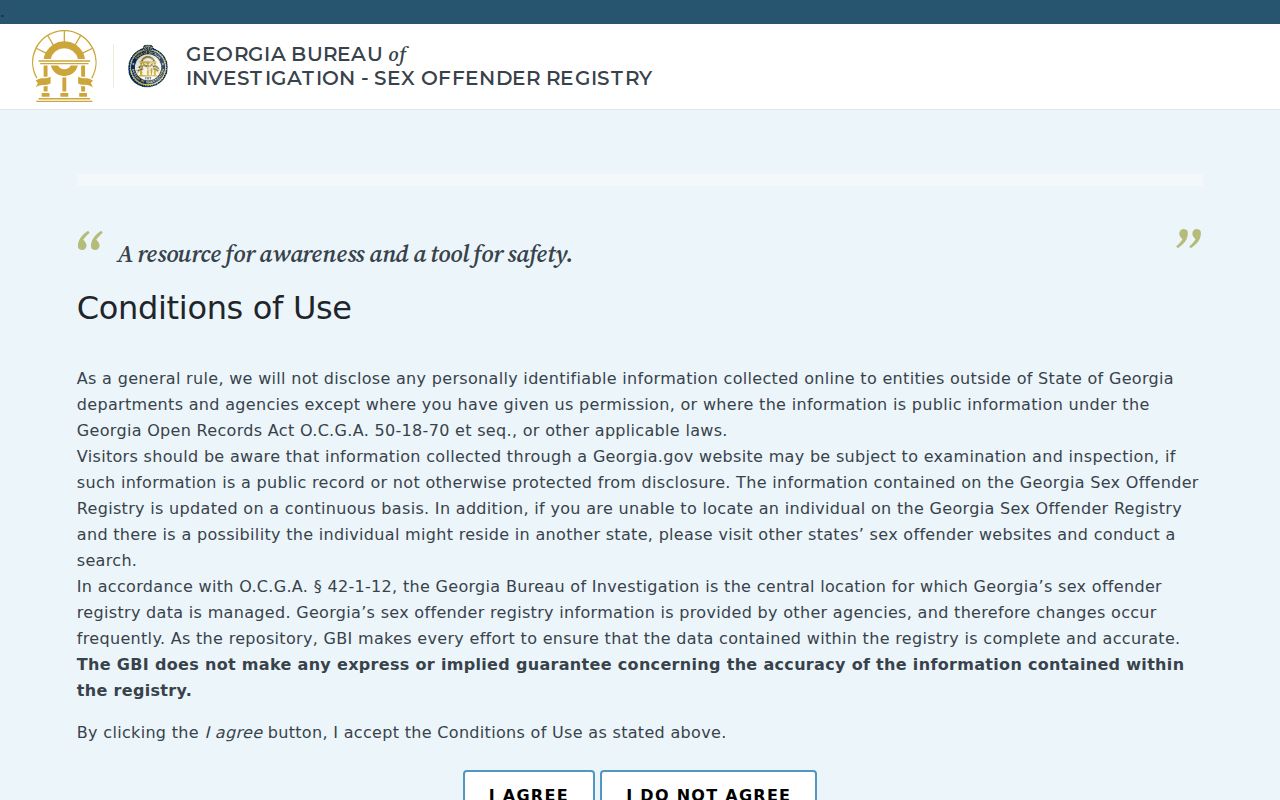
This state search is the closest public view of information reported through Georgia’s registration system; it should still be checked against the details inside each individual profile.
Muscogee County Registry Update Timing
The registry’s two-stage update path matters. A registrant ordinarily reports required information or changes to the sheriff. The sheriff then supplies updates to GBI within the statutory two-business-day period, and GBI refreshes the public registry daily. A move or other recent change can therefore be in transit between local intake and statewide publication. The displayed update date is more useful than assuming every screen represents the same moment.
Required registrants generally renew in person each year within 72 hours before their birthday, providing a current photograph and fingerprints. A person classified as a sexually dangerous predator has an additional reporting point six months after the birth month. Incoming Georgia registrations and reportable changes also commonly carry 72-hour duties. These are reporting rules for registrants, not a guarantee that every public field appears instantly.
The GBI registry FAQ explains update cadence and reasons a person may not appear.
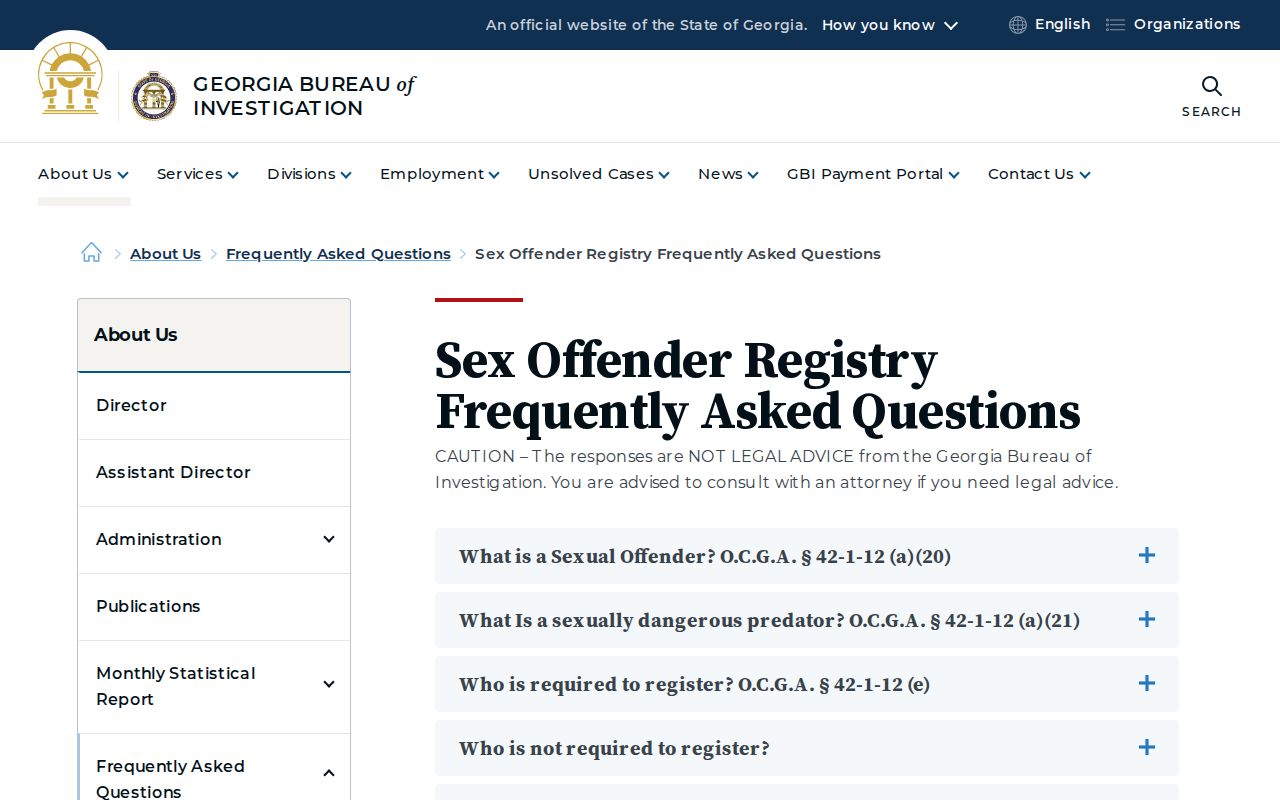
That FAQ is the appropriate reference when a recent registration, First Offender treatment, removal, death, or incorrect search information may explain a no-result.
Georgia Sex Offender Registry Searches
Use only controls that the live GBI interface presents. Dynamic options can change, so do not assume a particular radius or status choice will always be available. A sound search sequence is:
- Open the official Georgia public registry and review its conditions of use.
- Enter a name or select Muscogee County; add city, ZIP, address, or radius details only when useful.
- Compare the result list by photograph, age, physical description, address, and registration status instead of relying on a name alone.
- Open the full profile and read the offense, conviction jurisdiction, classification, verification, and update information together.
| Field or Control | Type | Required | How to Use It |
|---|---|---|---|
| Name | Text | No | Try first and last names and cautious spelling variants. |
| County | Dropdown | No | Select Muscogee for a countywide result set. |
| City or ZIP | Text/filter | No | Narrows geography when the reported area is known. |
| Address and radius | Address/map | No | Availability varies in the live interface; geocoding accuracy matters. |
| Offender type or status | Filter | No | Use Georgia labels; do not substitute federal tier language. |
| Map or list | View control | No | Changes presentation, not the underlying reporting duty. |
Muscogee County Registry No-Hit Context
A blank result does not prove that a person has never been required to register. GBI identifies several possible explanations: incorrect search information, a new registration not yet submitted, death or lawful removal, an offense that does not trigger registration, or successful completion of qualifying First Offender treatment. A spelling change, alias, county move, or narrow geographic filter can also affect a practical search.
Repeat the query with fewer filters and compare known identifiers. If the concern involves a person believed to be out of compliance in Muscogee County, contact the sheriff or GBI rather than confronting anyone. If the question is about the conviction or disposition behind a listing, use the clerk-held case record; a registry profile is a statutory notification summary, not the complete docket.
Registry Profiles: What They Show
Public fields differ by record and by what the law permits. Georgia’s backend collection can contain more sensitive material than the public view. The public profile generally emphasizes identification, location, offense, and status information needed for notification.
| Name & Aliases | Displayed name and reported aliases used to distinguish similar identities. |
|---|---|
| Photo & Description | Photograph, sex, race, age or date information, height, weight, hair, eyes, and identifying marks where public. |
| Registered Address | Reported residence or location information; visibility and precision depend on the record and law. |
| Offense & Conviction | Qualifying offense, statute, conviction jurisdiction, and date where displayed. |
| Georgia Classification | Level I, Level II, or sexually dangerous predator when an assessment applies. |
| Status & Verification | Registration or supervision county, status, vehicle information where shown, and last verification/update. |
Social Security numbers, fingerprints, full birth data, employment or school details, and other backend fields are not guaranteed public profile items. Absence of a field should not be read as evidence that the sheriff never collected it.
Muscogee County Cross-Border Registry Search
Muscogee County sits on Georgia’s boundary with Alabama, so a county-only filter cannot answer every geographic safety question. The U.S. Department of Justice’s national public website aggregates participating jurisdiction searches and provides a useful second layer when an address, commute, family connection, or recent move crosses state lines. It does not replace the source jurisdiction’s profile.
The Dru Sjodin National Sex Offender Public Website is the official national search point.
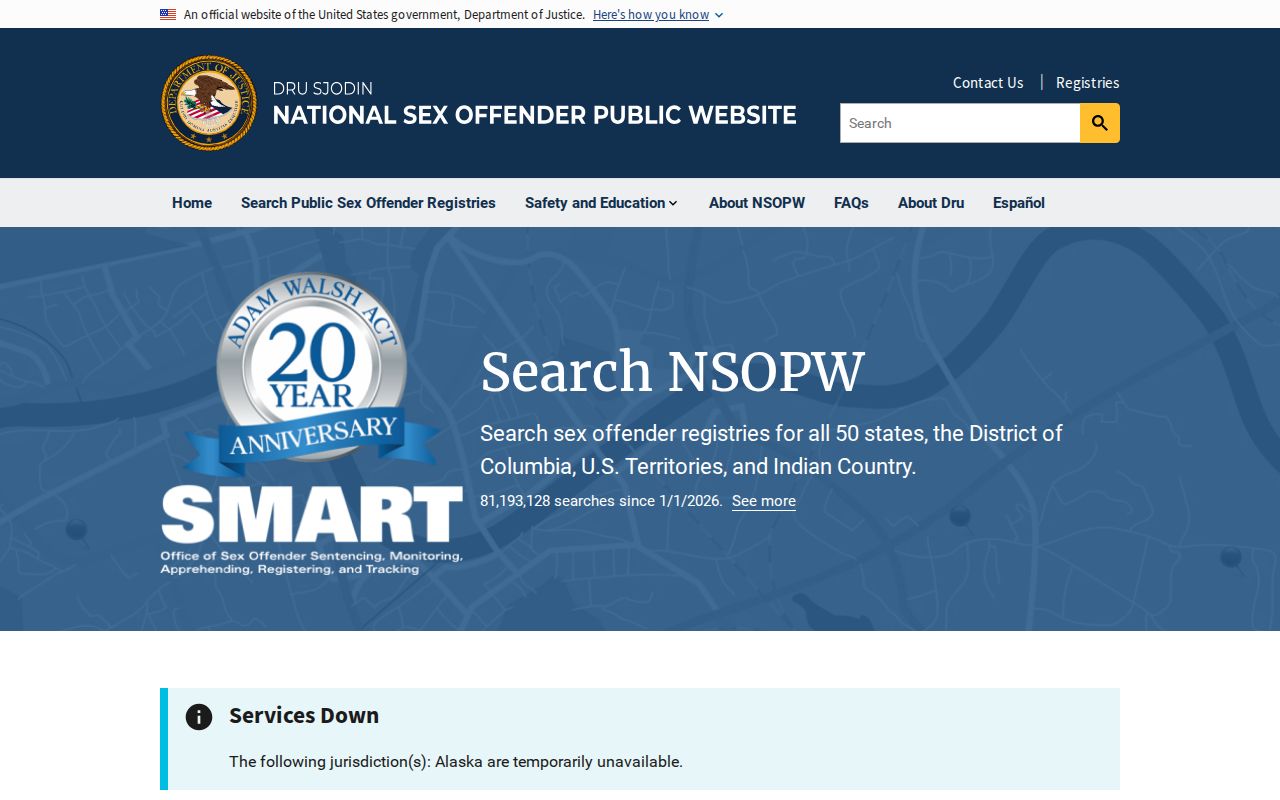
Open the underlying state or territory record from a national match and compare its dates, identifiers, and jurisdiction-specific terminology before relying on it.
Registration Levels and Duties in Georgia
Georgia uses risk-assessment labels created under O.C.G.A. § 42-1-14. They are not federal SORNA Tier I, II, and III designations. Registration is generally for life unless a court or another legal mechanism removes the duty, with petition possibilities under O.C.G.A. § 42-1-19.
| Georgia Classification | Duration | Verification or Visibility |
|---|---|---|
| Level I | Generally lifetime unless lawfully removed | Low-risk assessment; public classification where applicable and annual in-person renewal. |
| Level II | Generally lifetime unless lawfully removed | Intermediate-risk assessment; annual in-person renewal. |
| Sexually dangerous predator | Lifetime | Enhanced statutory monitoring/reporting, including an additional six-month report. |
The GBI risk-level resource describes Georgia’s assessment framework.
Using the state’s exact labels prevents the common error of assigning federal tier durations to Georgia classifications.
Muscogee County Offender Location Rules
Residency and activity restrictions depend on the offense date, the person’s status, the protected location, and the version of the statute that applies. O.C.G.A. § 42-1-16 includes a 1,000-foot rule for specified conduct during the 2006 to 2008 period and severe felony penalties for a knowing violation. It should not be flattened into a claim that one distance rule applies identically to every registrant.
A map circle is therefore a search aid, not a legal boundary determination. Questions about compliance should go to the Muscogee County Sheriff or GBI. Questions about the governing order, conviction, or later relief require the actual court record and case-specific legal review.
Muscogee County Offender Compliance Reports
A stale address, missed verification date, or other suspected violation should be reported through official channels. Preserve the public profile link, the displayed status and update date, and the specific observation that prompted concern. Send that information to the Muscogee County Sheriff or GBI. The agencies can compare public information with registration records that are not exposed on the website and determine whether follow-up is warranted.
Do not attempt to verify residence by entering private property, following a person, photographing household members, or publishing unconfirmed claims. The public view can lag a properly reported change, and some backend fields are intentionally withheld. A factual report gives investigators something usable while avoiding the danger and legal risk of private confrontation. If conduct presents an immediate threat, use 911; a registry compliance report is not an emergency-response substitute.
Using Registry Information Lawfully
The public registry supports personal, family, neighborhood, and community awareness. Review dates and source details, use official channels, and report suspected violations to law enforcement. Do not contact, follow, threaten, publish private household information about, or organize action against a listed person or family. The registry does not authorize private enforcement.
Use the registry responsibly: O.C.G.A. § 42-1-12 warns against criminal misuse of registry information. Harassment, threats, intimidation, and vigilantism can be crimes; report suspected noncompliance to the Muscogee County Sheriff or GBI instead.
When a profile appears inaccurate, note the URL, name, and displayed update date and send the concern to the maintaining agency. When immediate safety is at issue, call emergency services. Registry information is one official notification layer, not a substitute for emergency response or a complete assessment of any person.