
Columbus Criminal History Checks
Choose a Columbus source by record type and time in the process. A recent incident begins at Columbus Police Department. A person taken into custody moves into the Muscogee County Jail system. A citation or first appearance may involve Recorder’s Court, while a committal matter may involve Municipal Court. State Court or Superior Court becomes the better source after charges are formally prosecuted.
- Search CPD’s previously released NextRequest material or identify the police report needed.
- Request the incident or crash record through the correct CPD channel and provide names, date, location, and report number when known.
- Check Recorder’s Court for a citation or first appearance, or Municipal Court for a warrant application or committal matter.
- Move to Muscogee Smart Search, Jail Search, or the clerk when booking, filed charges, or a certified disposition matters.
- Use GCIC self-inspection or another authorized Georgia channel only when the inquiry truly needs the statewide repository layer.
The city route answers where an event began. The county docket answers what prosecutors filed and how the case ended. Readers needing deeper docket detail can use the Muscogee County court case lookup after locating the city incident or citation.
Why Columbus Is the Only City Guide
Columbus and Muscogee County consolidated in 1971. The Census Bureau classifies the resulting government as municipal and identifies no separate functioning county government; its state geography map shows no second incorporated city in Muscogee County. That is why official pages alternate between Columbus and Muscogee names and why a second local city guide would be misleading.
The Census Bureau’s July 1, 2025 estimate placed Columbus at 202,171 residents, compared with 206,922 in 2020. The consolidated area covers 216.50 land square miles. One downtown network of police, jail, court, and clerk counters therefore serves a broad geographic area, including a large military and veteran community associated with nearby Fort Moore.
Records at the Columbus Police Department
Columbus Police Department, founded in 1831, is the principal municipal creator of incident and arrest reports. The department operates from the Public Safety Building at 510 10th Street, Columbus, GA 31901; the public number is 706-225-3205. Its records do not automatically move to the court clerk as police reports. The clerk holds court filings and outcomes, not CPD’s investigative narrative.
Crash reports are available through BuyCrash or Desk Services in the lobby, subject to Georgia access limits for involved people and insurers. Incident reports can be collected from Desk Services. Broader requests belong with CPD Open Records by portal, email, in person, mail, phone, or fax.
The official Columbus Police Department page identifies the municipal agency and its public resources.
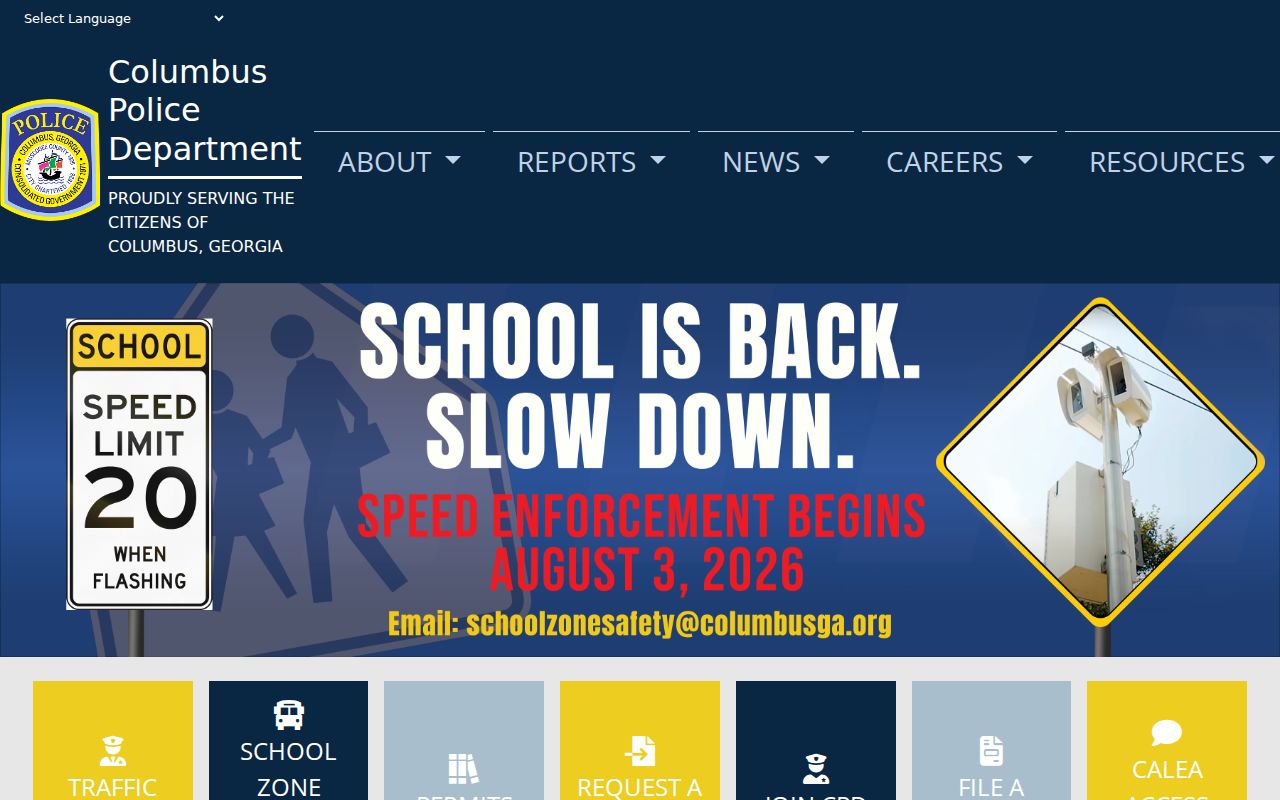
The department page is a useful starting point for current contacts, but the report and open-records channels below lead more directly to the records themselves.
Five Ways to Request CPD Records
CPD’s access sweep is unusually complete. Search previously released requests and responsive documents in NextRequest before opening a new request. A written request can also be emailed to cpdopenrecords@columbusga.org, delivered to Desk Services, mailed to the Open Records Compliance Office at P.O. Box 1866, Columbus, GA 31902-1866, or faxed to 706-225-4315. Process questions go to 706-225-4306.
| Channel | Exact Access | Best Use or Limitation |
|---|---|---|
| NextRequest | cityofcolumbusgapd.nextrequest.com | New requests and previously released responsive documents; interactive fields can change. |
| cpdopenrecords@columbusga.org | Written request with incident identifiers and preferred format. | |
| In person | Desk Services, 510 10th Street | Incident or crash pickup; bring names, date, and report number if known. |
| P.O. Box 1866, Columbus, GA 31902-1866 | Formal request with attachments or a paper trail. | |
| Phone or fax | 706-225-4306 / 706-225-4315 | Process questions or fax submission. |
| Citizen Connect | Columbus public-data interface | Requires a supported modern browser; use another channel if it will not render. |
The CPD Open Records resource collects the formal access information.
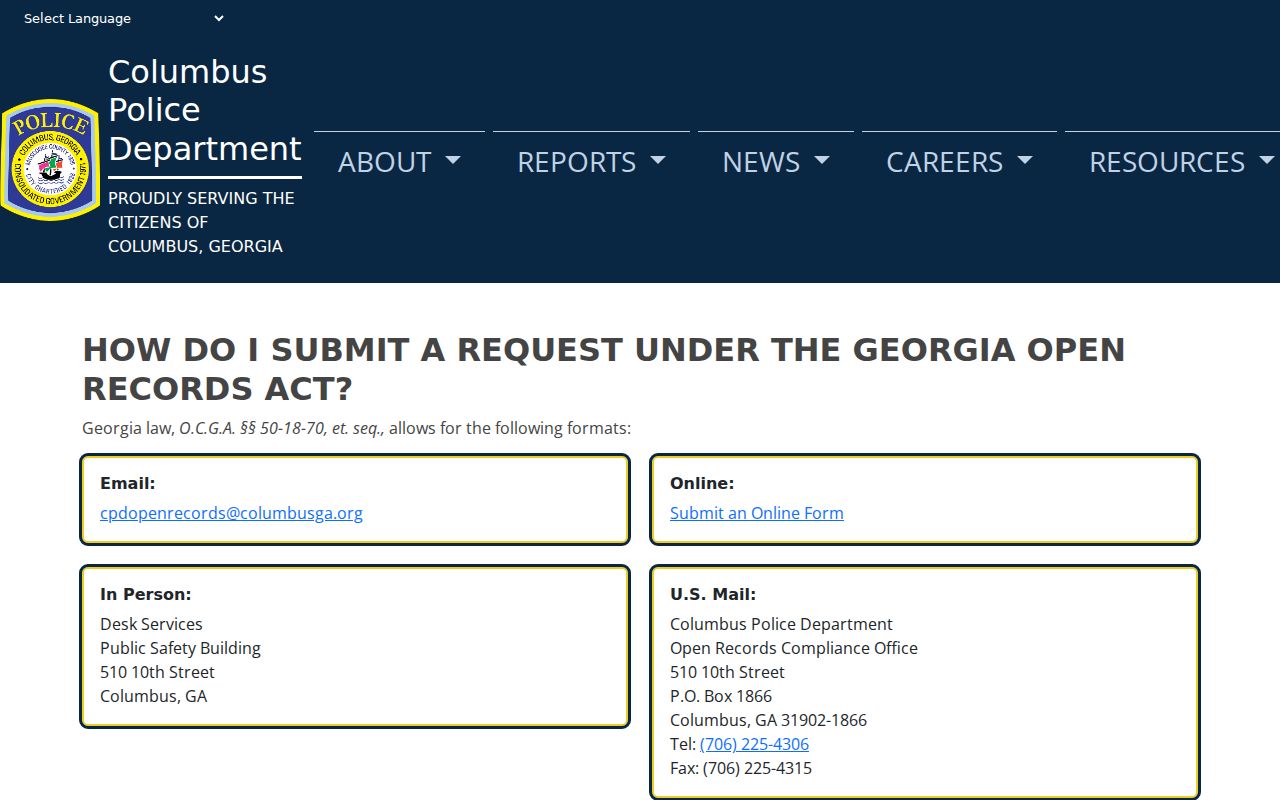
This formal route is appropriate for broader records, video, 911 material, or requests that require review and redaction rather than simple counter pickup.
Booking and Arrest Records in Columbus
CPD does not operate a separate public city jail. A Columbus arrest flows to the Muscogee County Jail at 700 East 10th Street. The sheriff’s Identification Section fingerprints and classifies inmates for every Muscogee law-enforcement agency, which is why a CPD arrest can appear under a county jail system soon after intake.
For current or recent custody, try Tyler Jail Search and use 706-653-4258 when the online service fails or the status needs confirmation. For the original account of the event, request the CPD report. For charges as filed and the legal outcome, check State or Superior Court. The Muscogee County arrest search explains the countywide booking and fallback channels in more depth.
A booking charge reflects the probable-cause and intake stage. It may be amended, dismissed, replaced, or prosecuted differently. Do not read an arrest or booking as proof of guilt, and do not infer the disposition from the wording on an early custody entry.
Columbus’s Three-Day Rule Has Limits
Under Georgia’s Open Records Act, CPD says readily available records receive a response or production within three business days. That period is a response-and-availability framework, not a promise that every complex request is complete within three days. The department specifically warns that 911 material may take two to eight weeks.
CPD calculates qualifying search, retrieval, redaction, and production labor from the prorated salary of the lowest-paid qualified employee, then adds $0.10 per page and postage after its stated $2 minimum. Requests under $25 may be released with an invoice. From $25 through $500, the requester must agree to an estimate. Above $500, prepayment is required. Narrow dates, locations, incident types, and known report numbers can reduce avoidable search time.
The CPD report-request page separates routine report pickup from broader open-records work.
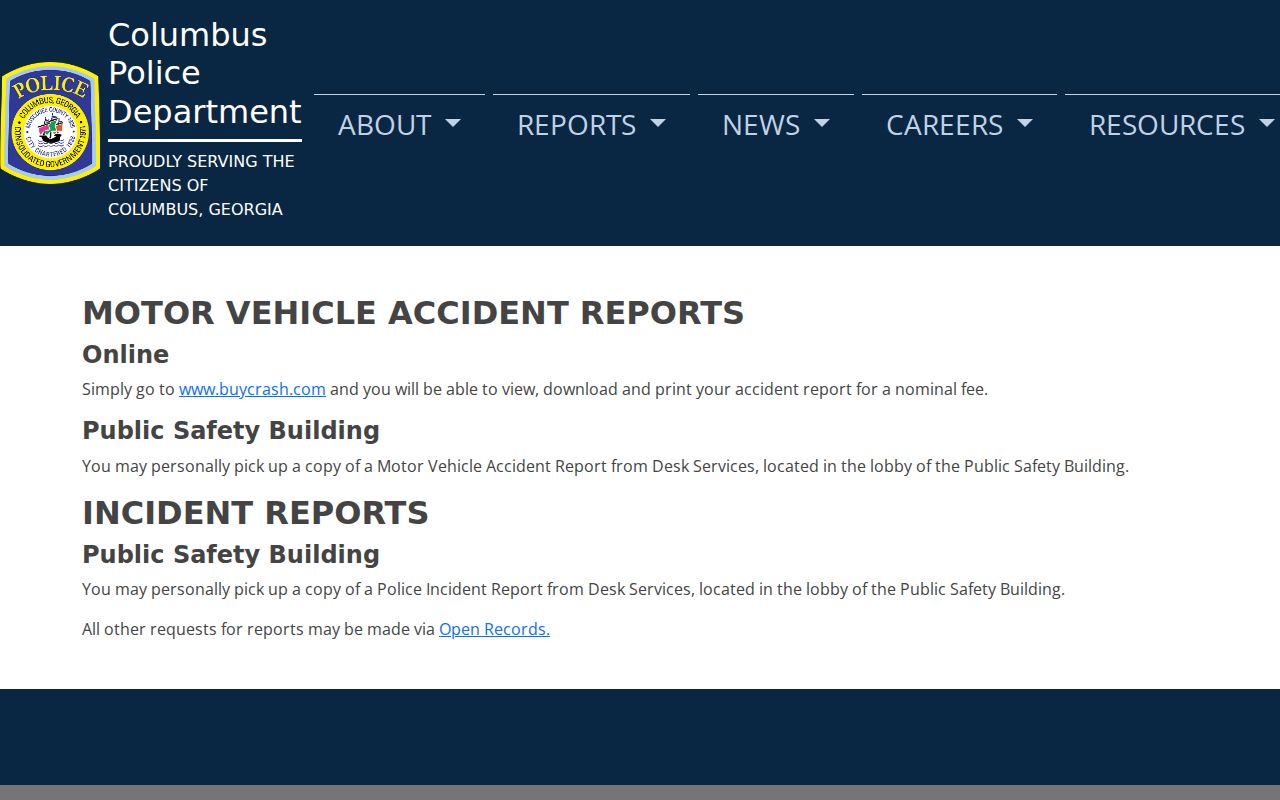
Using the report channel for a known incident and the open-records channel for a broader search helps the department route the request correctly.
The Columbus Municipal Court File
Columbus Municipal Court and Recorder’s Court are separate offices. Municipal Court is in the Government Center at 100 10th Street, eighth floor, and can be reached at 706-653-4378. In criminal matters it principally acts as a committal court, may accept pleas and sentence in authorized matters, and conducts probable-cause review before contested state-law matters proceed to State or Superior Court. Its clerk also handles warrant applications and specified misdemeanors alongside civil duties.
| Court Name | Columbus Municipal Court, Government Center eighth floor. |
|---|---|
| Criminal Role | Warrant applications, specified misdemeanors, authorized pleas or sentences, and probable-cause/committal functions. |
| Lookup Channel | Municipal clerk at 706-653-4378 and Muscogee ePortal as the matter proceeds; do not use the civil-heavy forms page as a criminal-record request form. |
| File Contents | Applications, court events, probable-cause actions, pleas or orders within its jurisdiction; later State/Superior files are held by the county clerk. |
| Copies & Fees | Confirm the current copy method and charge with the maintaining clerk before ordering. |
A committal decision is not a trial verdict. It determines whether probable cause supports routing the matter to the court with jurisdiction over the filed offense.
Recorder’s Court Handles Citations
Recorder’s Court is beside the jail at 702 10th Street, 706-653-4256. It handles CPD and other agency citations, first appearances, and probable-cause functions. Its online fine estimator begins with a Select a Citation dropdown, then allows a citation to be added, reviewed by code and description, and calculated. Speed-related selections can request the posted limit, actual speed, and school-zone, construction-zone, or school-bus details.
Some choices return “Court Appearance Required.” That is an instruction, not a missing result. Mail payment requires the citation, printed form, check or money order/cashier’s check, and a telephone number. Online payment must meet the portal and court cutoff. If the citation does not appear, call Recorder’s Court instead of assuming that the ticket vanished or no case exists.
The Recorder’s Court fine calculator shows the city’s citation controls.
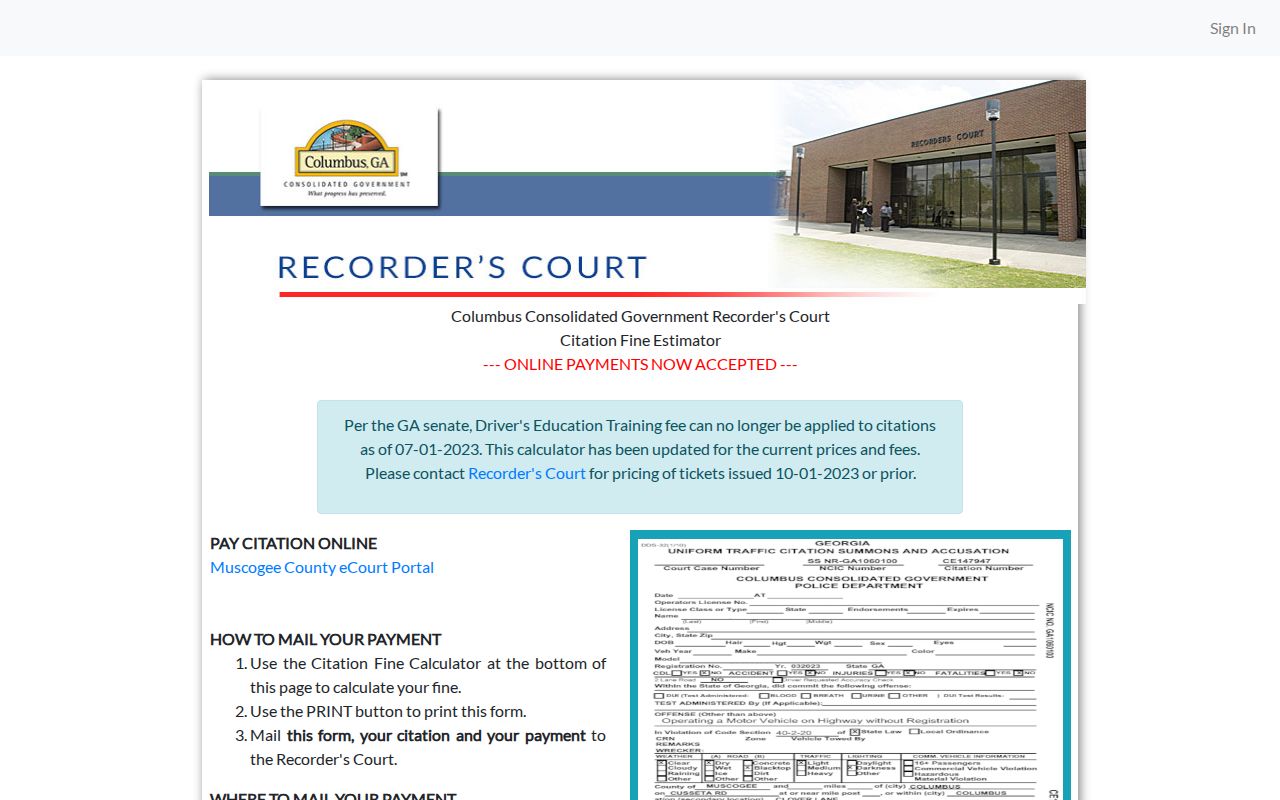
The calculator estimates eligible fines; it does not replace the docket, satisfy a required appearance, or establish the final outcome of a related criminal matter.
Choose a Crash or Incident Record
A crash report, incident report, and open-records request are three different access paths. Use BuyCrash or Desk Services for a collision report when Georgia’s eligibility rules allow access. Ask Desk Services for a known incident report when the event, date, names, and report number are already identified. Use CPD Open Records when the request is broader, seeks multiple incidents, asks for video or 911 material, or requires a records custodian to search and redact responsive documents.
Choosing the narrowest correct route avoids sending a routine pickup through a complex production process. It also prevents a common mistake: requesting a police narrative from the court clerk. The clerk may have an accusation, indictment, hearing event, judgment, or certified disposition arising from the same occurrence, but it does not maintain CPD’s original report. Conversely, the police report does not establish the final charge or court outcome.
When identifiers are incomplete, give the best bounded description available: date range, location, involved name, incident type, and preferred delivery format. NextRequest’s previously released material may answer a broad request before a new submission is needed, but a prior release should still be checked for its date and scope.
Muscogee eCourt Connects City Cases
Once a Columbus matter reaches the county court system, Muscogee Smart Search can query by record number or a name formatted as last, first, middle, suffix. Locations include Municipal, Recorder’s, State, Superior, Jail, Probate, and other portal divisions. Searchers can include cases, judgments, and warrants and refine by party, nickname, business name, sounds-like matching, dates, status, case type, judicial officer, or identifiers such as booking and SO numbers.
The public interface does not state that an account is required for ordinary Smart Search, though court-agency functions offer sign-in and registration. JavaScript, cookies, and a supported browser are needed, and inactive sessions expire. When it will not render, use the clerk counter, the relevant court phone number, or the written request channel rather than concluding that the record is unavailable.
How Columbus Records Reach the County
A Columbus case changes custodians as it develops. CPD creates the incident or arrest report. The Muscogee County Sheriff records intake, fingerprints, booking, and custody. Recorder’s or Municipal Court handles the applicable early proceeding. The Solicitor General prosecutes State Court misdemeanors, while the District Attorney prosecutes Superior Court felonies. Reported dispositions then feed the Georgia Crime Information Center repository.
Record flow: Columbus Police Department › Muscogee County Courts › Georgia Crime Information Center
The flow is not a replacement chain in which later offices absorb every earlier document. A clerk’s certified disposition establishes the court outcome, but it does not reproduce CPD’s full narrative. A GCIC history compiles submitted arrest cycles and reported outcomes, but it is organized differently from a local docket. Ask each custodian for the record it actually creates.
Columbus Record Access Rules
Georgia law favors public access while preserving exemptions and separate criminal-history dissemination rules. Active investigative material, confidential sources, protected personal information, juvenile material, and restricted criminal-history information may be withheld or redacted. An agency should separate nonexempt material when feasible rather than treating every mixed record as wholly closed.
Key Statutes:
O.C.G.A. § 50-18-70 states Georgia’s policy favoring open public records.
O.C.G.A. § 50-18-71 governs response, production, and cost procedures.
O.C.G.A. § 50-18-72 identifies exemptions such as protected investigative and personal information.
O.C.G.A. § 35-3-34 separately controls dissemination of Georgia criminal-history information.
Restricted information under O.C.G.A. § 35-3-37 is removed from ordinary public and private criminal-history dissemination but remains available to specified justice users. A Columbus police request cannot override those limits, and a portal no-result should not be treated as proof that no protected record exists.